
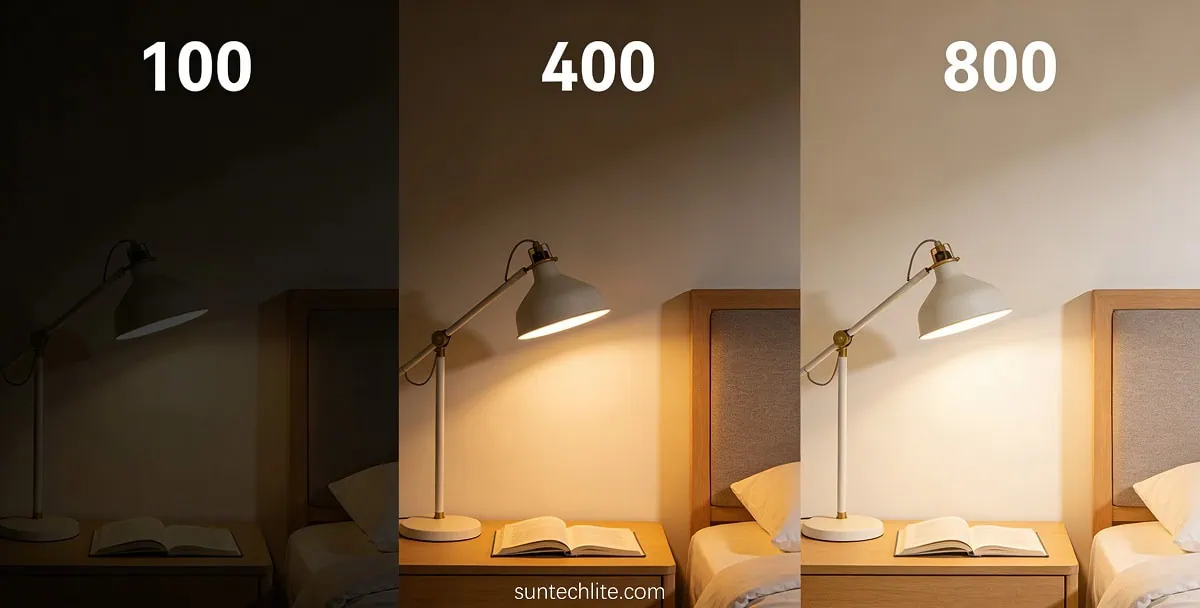
How bright is 400 lumens?
400 lumens is a moderate and comfortable level of brightness.
At 400 lumens, the light gently fills the space without being harsh. You can clearly see the pages of a book. The table, walls, and surrounding area are all visible. But it never feels too bright.
The light, feels warm and well balanced.
It’s not like 100 lumens, where the space looks dim and underlit. And it’s not like 800 lumens, where everything is very bright and fully illuminated.
400 lumens sits right in the middle. Clear, soft, and comfortable.
Understanding 400 Lumens
Before we talk about real life use, let’s quickly understand what “lumens” means.
Lumens measure brightness, not power
- 1 lumen ≈ the light from a single candle
- 400 lumens ≈ the light from about 400 candles combined
So when we say 400 lumens, we are describing how much visible light the source puts out, not how much electricity it uses, and not how much of that light reaches a surface.
Think of lumens as “how much light you get,” not “how much energy you spend.
How Bright Is 400 Lumens?
At 400 lumens, the light feels soft and comfortable, without being harsh or glaring.
It creates a calm and relaxing atmosphere that’s easy on the eyes.
Instead of trying to light up an entire space, 400 lumens focuses on practical, close-range lighting where you need it most.

In real life, this level of brightness is commonly used for:
- bathroom night lights
- dining table accent lighting
- shelf or display lighting
- entryway lighting
- hallway lighting
- outdoor pathway lighting
Suntechlite is a professional LED lighting manufacturer offering free lighting solution support. We provide a wide range of LED strip lights and neon flex products designed to deliver soft, uniform illumination at around 400 lumens.
- LED strip lights are ideal for indirect lighting, such as under cabinets, along walls, or on steps
- LED neon flex is perfect for decorative or pathway lighting, producing smooth and evenly diffused light
400 Lumens to Watts
Watts measure energy use. Lumens measure brightness.
The same number of lumens means the same level of brightness, no matter how many watts are used.
For example, 400 lumens is roughly equivalent to:
- 27 watts of incandescent light
- 20 watts of halogen light
- 4.5 watts of LED light
For more details, you can check a lumen to watt calculator.
So this is why LEDs are more efficient.
LEDs produce more light while using less energy. This is known as luminous efficacy (lm/W).
400 Lumens vs Lux vs Candela
Same 400 lumens, why it feels different brightness?
Same lumens, different brightness depending on space.
On a 1 m² area, 400 lumens feels bright at around 400 lux. When spread over 10 m², the same 400 lumens drops to about 40 lux and appears much dimmer.
Here you need to understand other common concepts related to lighting fixtures.

When choosing lighting, you will often see three terms: lumens, lux, and candela. They all describe light, but in different ways.
A lumen (lm) is the total amount of light emitted by a light source, like the amount of water flowing from a tap.
A lux (lx) is the intensity of light illuminating an object’s surface. 1 lux = 1 lm/m². Think of it as the depth of water on the ground.
A candela (cd) is the intensity of light in a specific direction, like the power of a water jet. However, candela is not affected by distance; the more concentrated the light, the higher the cd.
Here are the key relationships in a simple way:
1 lux means 1 lumen spread over 1 square meter
- If 400 lumens are evenly spread over 1 m², you get 400 lux
For an evenly emitting light source (in all directions):
- 1 lumen is about equal to 1 / (4π) candela
- So 400 lumens ≈ 31.8 candela
But for focused lights (like flashlights):
- Candela can be much higher
- Lux will change depending on distance
When to Choose Lumens?

Which One Should You Look At When Buying Lights? When buying lighting, it is easy to get confused by different terms.
- Should you look at lumens or flux when choosing ceiling lights?
- For plant grow lighting, should you focus on lumens or candela?
- For flashlights, which matters most: lumens, lux, or candela?
If you have asked these questions, you are not alone.
Understanding the right metric makes all the difference. It helps you choose lighting that actually works for your space, instead of just looking good on paper.
Table: Which Lighting Metric Should You Use When Buying Lights
| Metric | What It Means | Typical Uses | When to Use |
|---|---|---|---|
| 💡 Lumens (lm) | Total brightness of a light source |
• LED bulbs and tubes • Ceiling lights and panel lights • Desk lamps and flood lights • Projectors (ANSI lumens) • Car headlights |
Compare overall brightness |
| 🌟 Lux (lx) | Brightness on a surface |
• Office and classroom lighting • Street lighting measurement • Plant grow lighting • Photography light meters • Museums and galleries • Auto brightness sensors |
Evaluate how bright a space feels |
| 🔦 Candela (cd) | Light intensity in a specific direction |
• Flashlights • Headlamps and searchlights • Car high beams • Spotlights and track lights • Lighthouse and aviation lights |
Measure beam distance and focus |
Why 400 Lumens Can Look Dimmer
Even with the same 400 lumens, the way light looks can change a lot.
That’s because brightness is not only about output, but also about how light interacts with the environment.
Color Temperature
3000K warm white: The space looks soft and cozy. Light feels gentle and relaxing. Shadows are smoother, and the overall brightness appears lower.
5000K cool white: The space looks cleaner and sharper. Details stand out more, and the light feels stronger and more intense.

Why This Happens?
Cool white light contains more blue tones, which the human eye perceives as brighter. Warm white light contains more yellow tones, which feel softer and less intense.
This is why the same 400 lumens can look brighter under cool white light and softer under warm white light.
Brightness is not only about lumens. Color temperature changes how bright light feels.
Fixture Design
Even at the same 400 lumens, the way light is delivered can completely change how it feels.
Direct Lighting: The light is focused in one direction. The illuminated area appears brighter and more intense. Shadows are sharper, and the contrast is stronger.
Diffused Lighting: The light is spread evenly. The space feels softer and more balanced. Shadows are minimal, and the brightness appears more comfortable.

Why fixture design matters for 400 lumens?
With 400 lumens, direct lighting can make the light feel brighter and more concentrated. Diffused lighting can make the same light feel softer and more relaxing
The total light output does not change, but the perceived brightness and comfort level do.
Brightness is not only about lumens. Fixture design controls how light is distributed.
Beam Angle
How light spreads at different beam angles: 3°, 8°, 15°, and 24° ?
Even if all lights output the same 400 lumens, the visual brightness looks very different.
Why does this happen?
- Narrow beam (3°–8°): Light is concentrated in a small area. The center appears very bright and intense because the same light is packed into a tight spot.
- Medium beam (15°): Light spreads more evenly. Brightness is still clear but less intense than a narrow beam.
- Wide beam (24°): Light covers a larger area. The brightness looks softer and less focused because the light is distributed over a wider surface.

Same lumens does not mean same visual brightness.
Narrow beam = brighter spot
Wide beam = softer light
The difference comes from light distribution:
Narrow beams increase lux (light per area). Wide beams reduce lux by spreading the light out.
So even with the same 400 lumens, your eyes will perceive very different brightness. Depend on the beam angle.
TL;DR
400 lumens does not guarantee the same visual brightness. Beam angle, light fixture type, and color temperture all affect how bright the light appears.
If your lighting does not look right, the problem is not just lumens. It is the design.
At Suntechlite, we help you get the real brightness you need. From high lumen output LED strips to custom solutions, we make sure your lighting performs exactly as expected in real applications.
✔ High lumen output per meter
✔ Stable quality and long lifespan
✔ Custom beam, brightness, and design support
